Showing posts with label rape. Show all posts

Monday, December 31, 2012

Rez Family Speaks Out -


There’s another side to the ICWA that until very recently has received little disclosure or news coverage. Just why would a family (2-parent, single-parent, multi-generational, or blended) decide that reservation life is not what they CHOOSE for their family? The reasons are many, but some of the reasons are shocking.  

What cannot be denied is that a large number of Native Americans are dying from alcoholism, drug abuse, suicide and violence. Further, what is being hidden on some reservations is that scores of children are suffering emotional, physical and sexual abuse as a result of the accepted behavior on those reservations, and the ICWA is trapping more and more children into this unacceptable system.

While many tribal governments continue to fund congressional candidates who promise to increase tribal sovereignty, the voices of the children who are at the mercy of corrupt government continue to go unheard. The truth that must be revealed is that some tribal governments are not protecting the children in their “custody.” Some have said that there are children actually being traded and sold by the very people who are being paid to “foster” them. The Spirit Lake tribal government in North Dakota is not isolated in the mistreatment of children.

Though tribal governments claim there are accountability measures in place, in reality many children within the foster system never receive adequate care or any follow-up at all. Some tribal members report that extended family members, social workers, judges, lawyers, teachers, and other “mandated reporters” all seem to participate in this broken system where, as long as a child remains in foster care, the tribe and the custodian(s) receive a check. There is no incentive to permanently place an Indian child in an adoptive home, and no incentive to report abuse. The adults in charge simply turn a blind eye and pretend that the system works, and children are denied the most basic of human needs…real love and a safe place to call home.  

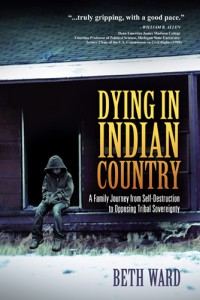
Dying in Indian Country, by Elizabeth Sharon Morris, provides a real glimpse into some of these unacceptable conditions. Dying in Indian Country tells a compelling true story of one family who comes to realize that corrupt tribal government, dishonest Federal Indian Policy, welfare policy, and the controlling reservation system has more to do with the current despair than tragedies that occurred 150 years ago.

“Dying in Indian Country is a compassionate and honest portrayal… I highly recommend it to you.” Reed Elley, former Member of Parliament, Canada; Chief Critic for Indian Affairs in 2000, Baptist Pastor, Father of four Native and Métis children

“He was a magnificent warrior who put himself on the line for the good of all…I can think of no one at this time, in this dark period of Indian history, who is able to speak as Roland has.” Arlene,Tribal Member

“…truly gripping, with a good pace.” Dr. William B. Allen, -Emeritus Professor, Political Science, MSU and former Chair of the U.S. Commission on Civil Rights (1989)

Dying in Indian Country is available at: http://dyinginindiancountry.com

Has God used CAICW to impact you or a loved one in 2012?
Consider impacting someone else by giving a gift
 

Tuesday, July 3, 2012

THE BOOK IS FINALLY DONE!


. Dying In Indian Country - by Beth Ward 
 Finally - after only fifteen years in the making and a lot of blood, sweat and tears - The book is finished.


________________________________

This is a true story of an American tribal member who, after coming to know Jesus Christ, realized just how much liberal policies within tribal and federal government were hurting his extended family.  

Roland grew up watching members of his family die of alcoholism, child abuse, suicide, and violence on the reservation. Like many others, he blamed all the problems on “white people.”  

Beth Ward grew up in a middle class home in the suburbs. Raised in a politically left family, she also believed that all problems on the reservation originated with cruel treatment by settlers and the stealing of land. Meeting her husband, her first close experience with a tribal member, she stepped out of the comfort of suburban life into a whole new, frightening world.

After almost ten years of living with his alcoholism and the terrible dangers that came with it, they both came to realize that individual behavior and personal decisions were at the root of a man’s troubles, including their own. After coming face-to face with the reality of Jesus Christ, their eyes opened to the truth of why there is so much Dying in Indian Country.  

What cannot be denied is that a large number of Native Americans are dying from alcoholism, drug abuse, suicide, and violence. The reservation, a socialistic experiment at best, pushes people to depend on tribal and federal government rather than God, and to blame all of life's ills on others. The results have been disastrous. Roland realized that corrupt tribal government, dishonest federal Indian policy, and the controlling reservation system had more to do with the current pain and despair in his family and community than what had happened 150 years ago.  

Here is the plain truth in the eyes of one family, in the hope that at least some of the dying in Indian Country — physical, emotional, and spiritual — may be recognized and prevented. Unfortunately, persistent public misconceptions about Indian Country, misconceptions sometimes promoted by tribal government and others enjoying unaudited money and power, have worked to keep the situation just as it is.

~~~~~~~~~~~~~~~~~~~~~~~~~~~~~~~~~~~~~~~~~~~~~~~~~~~~~~~~~~~~~~
  • “Roland truly has encouraged many people…the last trip to D.C. was a testimony to God’s faithfulness.” Rev. Robert Guthrie, B.Th. M.A. –Professor, Vanguard College, AB
  • “…he earned my deepest respect, and…made heroic and very honorable attempts to improve the lot of Native Americans in this country.” Jon Metropoulos, Attorney, Helena, MT
  • “‘Dying in Indian Country’ is a compassionate and honest portrayal…I highly recommend it to you!” Reed Elley, former Member of Parliament, Canada; Chief Critic for Indian Affairs in 2000; Baptist Pastor, father of four native and metis children
  • “I truly admire Roland for the message he was trying to have heard.” Ralph Heinert, Montana State Representative
  • “He was a magnificent warrior who put himself on the line for the good of all…. I can think of no-one at this time in this dark period of Indian history who is able to speak as Roland has.” Arlene, tribal member
  • “…hope emerging from despair… This is a story about an amazing life journey.” Darrel Smith. Writer, Rancher, South Dakota
  • “He’s a Christian now you know… I saw him crying on his knees on my living room floor. I was there.” Sharon, tribal member
  • "...truly gripping, with a good pace." Dr. William B. Allen, - Emeritus Professor, Political Science, MSU and former Chair of the U.S. Commission on Civil Rights (1989)

Read More:

.

Saturday, October 2, 2010

Children are Expedient: Nothing more

.
Having watched the young dancers at the powwows for several years, I was impressed. I imagined Andrew as a fancy dancer. Wanting him to have a chance to learn, I called the Indian Center and was told about a child's drum and dance group meeting every week at the health center. Roland wasn't interested, so I took Andrew by myself.

The room was lined with parents sitting on folding chairs against the wall and their children sitting on their laps or standing near. I found a place to sit and held Andrew in front of me. I was surprised at the discomfort I felt. Having been with Roland for 6 years, I no longer felt conspicuous around Indians. But there was something here that wasn’t right. I looked around for a familiar face, but my eyes met only hostile stares. I understood immediately I was not wanted. What I couldn't understand though was with all of the talk about the benefits of tribal culture, why would these people chase away a white person who was trying to make sure their child stayed connected to the tribal culture? We never returned to the class.

Candis was visiting Arnold's sister on the northeast side, and Annie asked if I would drive Savannah and her up there. Driving over a bridge on Aspen Street, I slid on black ice and rammed into the rear end of a nice little car. Unfortunately, I wasn't carrying insurance.

The owner and I both got out to look at the damage. His rear fender suffered only a small, inch long crack. I was relieved. No important damage occurred. However, he seemed to think it was important and asked for my name, address and phone number. In a panic, I lied and gave him false information.

At Arnold's sister's later that afternoon, we told them about the incident. After that, I put it out of mind.

A few days later Arnold paid me to taxi Candis and him home to his “Rez”, which neighbored Salmon Lake. Candis was about ten at the time. Dorothy’s son, Troy, was visiting for a few days and rode with us. It was a cold night. The snow fell softly and silently. It was late and we all were tired. We hadn't originally intended to stop anywhere, but we had gotten a late start, and the weather had slowed us down. I couldn't drive anymore, and was glad Arnold had suggested we stop at his sister’s house.

The house we stopped at, with shoulder high snowdrifts in the driveway, was an unexpected, beautiful, ranch style home. The owner, Arnold's other sister and her husband, were obviously employed. We weren't sure if anyone was at home at first, but their 15-year-old daughter finally answered the door. After she assured Arnold it was no problem for us to stay, she led me past the kitchen and down to the end of the hall where there was a room I could use to sleep with Andrew. It was a teenage girl's room. The twin bed had a fluffy, pink comforter and the furnishings and toiletries on the dresser were that of a bubbly adolescent. I guessed it was her room. I am not sure where she and Candis were to sleep that night. Arnold and Troy slept on the living room couches.

I don't know how long I had been asleep when I heard noises in the hall. I could hear a man laughing and talking in slurred, drunken fashion, and I could hear Candis laughing and answering, "No, no, leave me alone. Don't do that!" I heard a loud thump, and suddenly the door to my room flew open. In the darkness, the man pushed Candis onto my bed, onto my legs, and began fumbling with the zipper of her pants.

In horror, I sat straight up and screamed at the top of my lungs; "Get the H--- out of here!"

The man jerked up, turned to look at me, and then dashed from the room. To my surprise, Candis started after him. Quickly, I jumped out of bed and grabbed her by the arm, "No! Not you!" I slammed the door shut and pulled Candis back to the bed, putting her in-between myself and Andrew, (who had never awakened). I wasn't going to let anyone touch her if I could help it. But I could hear the man moving around in the kitchen, getting himself something to eat. The kitchen was in between the living room and us. How will I get to Arnold and Troy for help? Who was that man? What if he comes back with a gun, mad, or scared I’ll call the cops?

Candis fell asleep after a short time, but I sat in the room with the lights on for the rest of the night, too afraid to close my eyes. After a time, I could hear the man snoring, but I was still too scared to attempt to get past him. In my mind's eye, I pictured him sitting in a chair, sleeping with his head bent and his chin on his chest. What could I do? I was too afraid to leave the room.

Candis and Andrew slept peacefully beside me.
.

Saturday, August 7, 2010

Being Raised to Die

.
Wilson began working at an upholstery shop on the northeast side. It didn't pay much, but he was glad for the work. I was surprised how little trouble he had getting up with the alarm.


We signed Joy up for ballet classes in the suburb near my Dad’s. Every Saturday that fall, I dropped her off at class and went to do laundry at my dad's. We also signed Junior up with a gym near his house and paid for his and Cheri's piano lessons at the Park. In addition, Wilson and I attended most of Junior's floor hockey games and were proud when Cheri won an award in tennis.

But Misty wasn't a joiner. She had briefly been in Girl Scouts, but never asked to be part of any other program, never indicated any special interests, and we, deep into our own problems, never thought to help her find some.

Misty, like Cheri, started her real trouble after leaving elementary school and beginning junior high. There being several elementary and junior high schools in our large city, kids moving to seventh grade often found themselves surrounded by a whole new group of children. I often wondered if the pressure of a new school and the change in peer group at such an insecure age had anything to do with the troubles inner city kids had. Maybe junior high kids should be kept with the same group of children they'd gone to elementary school with, rather than shuffling the children as you would a deck of cards.

Because of Misty's truancy, the school district was now picking her up in a van every day from her mother's house and taking her to a special school. But the costly effort had no effect on her uncooperative attitude or interest in learning.
_________________________________

An Asian gang had jumped Savannah and Yvonne’s girl, Marci. Marci had gotten away, but Savannah was left. She had been gang-raped. Only thirteen, Savannah was already drinking heavily, had left school, been beaten several times, been stabbed in the throat, and had had clap (gonorrhea). I tried to get Savannah into treatment. The hospital was ready to take her, but no one in the family would help me to get her there. At the duplex Annie and Savannah were staying at with other people, (Candis was in the custody of her dad at the time.) I tried to talk Annie into helping me with Savannah.

"Well Savannah don't want to go, and if Savannah don't want to go, I can't do nothin," Annie said.

Busy at the kitchen table trying to hack a dirty cast off a little boy’s arm, she stopped a moment to take drag on her cigarette. I didn't know who the boy was. The son of the person Annie was staying with I guessed.

"Well, could we just trick her? Just tell her we're visiting someone?"

"Na-e, she won't fall for that," Annie said as she worked.

It was clear I wasn't going to get any help, so I gave up. After all, these adults were heavy drinkers and living homeless, transient lives themselves. Savannah was only a kid and wasn't near as bad off as they were, so in their minds, I was silly to suggest she needed help.

"By the way”, I said gesturing toward the boy. “How come you don't just bring him down to the hospital and have them cut that cast off? It would be easier."

"Nae, his mom don't want to bother with that."

More likely she didn't want to sober up for it or was hiding from social services.
__________________________________

One day, as I came into Wanda's duplex, Julia jumped up from the table in confusion, looked frantically around for a place to hide, and then ran into the basement. She had been sniffing paint and didn't want me to know.

Wilson and I began to talk about the troubles all the teenagers were having and wondered if there was something that we could do to make it different. For a little while, we even bandied around the idea of running a home for Indian kids. At the time, the Native American community in this city was predominately located within a two-mile radius. It was estimated there were approximately 15,500 Indians in the area. According to statistics, Native Americans had a higher infant mortality, lower education attainment, higher unemployment rates, greater incidence of poverty and disproportionately higher chemical dependency rate than other people groups in the state. Statistics said that 40% of this state’s Indians had a serious problem with alcohol, as opposed to only 8.5% of the rest of the state population. It was considered the single most serious problem Indians faced because it contributed to the three leading causes of death in adults: cirrhosis of the liver, suicide, and homicide.

And many youth were following their parents’ path.

.